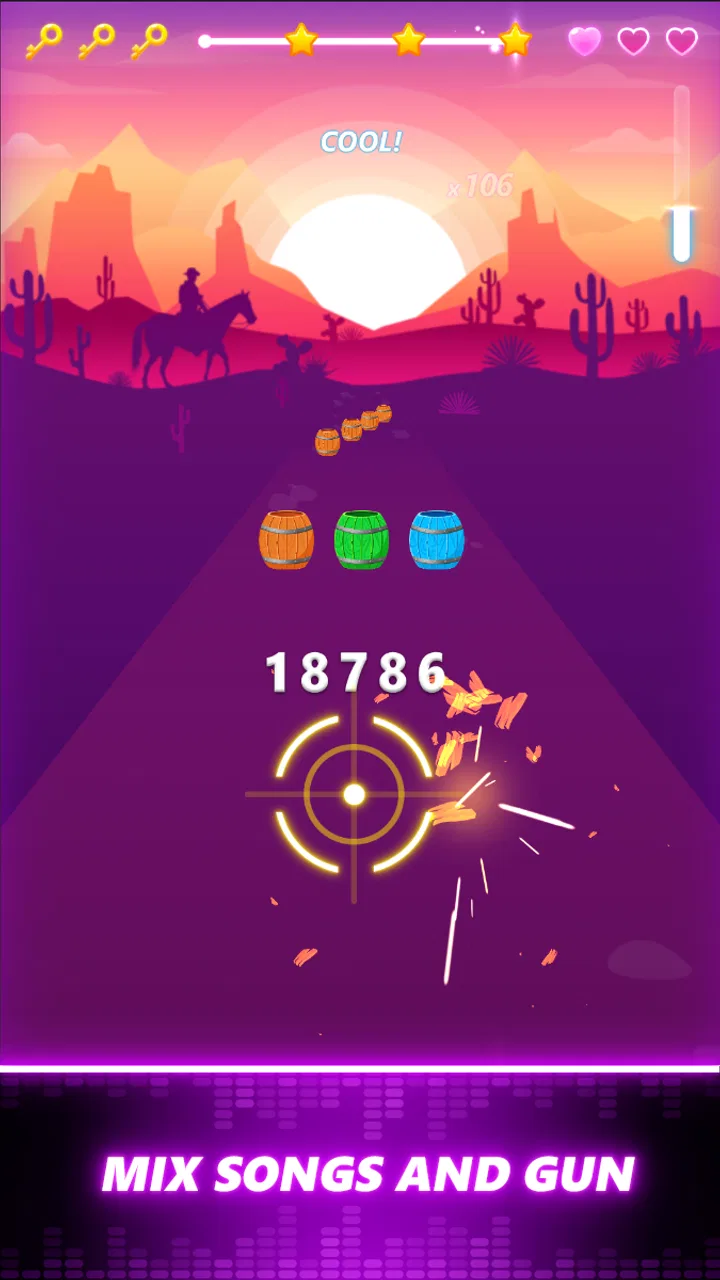
Beat Shoot 3D:EDM Music Game
- 4.7
- Rating
- 1.00M
- Installs
- Free
- Price

 Analysis by App-foxy
I approached Beat Shoot 3D as a quick music game rather than a serious rhythm-training tool, and that distinction matters. It combines beat matching with shooting, bright three-dimensional presentation, electronic music, and a story mode associated with the familiar FNF style. The result is immediately understandable: listen, watch the timing, and fire along with the track. I could start playing without studying a complicated rulebook, which is exactly why the first sessions feel so inviting.
It is a free game from BeatFun in the Music category, aimed at Teen players. The store page shows a 4.7 average from roughly three and a half thousand ratings, while its install count has passed one million. Those figures suggest that the basic idea has found an audience, but they do not answer the more useful question: does the game remain enjoyable once the initial novelty of shooting to a beat wears off? My experience is mixed in an interesting way. The core loop is easy to revisit, yet the long-term appeal depends heavily on how much variety and challenge you personally need.
From instant hook to a repeatable music habit
I look at the move from first-play novelty to a lasting routine through a practical lens: what makes another short session worthwhile once the shooting-to-the-beat idea feels familiar? A useful test is to choose one track or story segment and return to it with a specific timing goal, rather than playing on autopilot. That makes it easier to tell whether the game’s rhythm loop genuinely suits you.
You May Also Like

 Blood Strike: 2.5 Anniversary
Blood Strike’s Loadouts Turn Every Drop Into a Tactical Gamble
A close look at Blood Strike’s custom loadouts: how fast access to signature weapons reshapes its battle royale rhythm, rewards preparation, and narrows the gap between fights.

 Pandora - Music & Podcasts
Pandora’s Music Is Easy to Start, but Harder to Recover
Pandora’s strength is its low-effort path from a seed to a station. Its weak spot is how much confidence it asks you to place in connection, setup, and quiet recovery.

 8 Ball Pool
 Is Built on Rivalries, Rematches, and Routine
A close look at the rivalries, rematches, shared routines, and unanswered safety questions that turn a quick pool match into a persistent mobile community.

 Samsung Music
’s Quiet Strength Is Playing What You Already Own
Its reach comes less from spectacle than from dependable access to a personal library. That simplicity is both the app’s strongest retention engine and its ceiling.

 AccuWeather: Weather Radar
AccuWeather Review: A Quick, Clear Forecast for Everyday Decisions
For everyday plans, the best forecast is the one you can understand quickly. AccuWeather makes rain timing, radar, and local conditions easy to act on, with a few trade-offs.

 Hill Climb Racing
Why Hill Climb Racing Still Turns Crashes Into One More Run
A tiny car, a bumpy hill and one more upgrade: Hill Climb Racing keeps resurfacing because its simple chaos makes every near-miss feel personal.
More From Our News Desk



Why the first sessions work so well
The strongest part of the opening experience is how quickly the game communicates its purpose. A conventional music game may ask me to follow lanes, tap notes, or hold buttons in a strict sequence. Here, the weapon theme gives every successful beat a little more physical energy. I am not simply pressing a note; I am firing into the rhythm. That small change makes familiar timing mechanics feel more active, especially when the music has a pronounced electronic pulse.
The three-dimensional presentation also helps the game stand apart from a basic tap-to-the-beat app. It gives the action a sense of movement, even when the underlying task remains straightforward. During a short break, I can pick it up, understand the current pattern, and play without committing to a long session. That makes it a natural fit for waiting rooms, public transport, or the few minutes before bed when I want something more engaging than scrolling.
The FNF story mode is another useful entry point. Players who enjoy rhythm games with character-driven progression may prefer having a sense of direction instead of selecting disconnected songs. I like that the game can be approached as both a music challenge and a light progression experience. The story framing gives the early sessions a reason to continue, while the beat-and-shoot mechanic remains the main attraction.
There is also a practical advantage in the controls: the action is visually direct. When the screen shows the timing clearly, I can concentrate on the beat instead of remembering a complicated control layout. That simplicity does not make every section easy, but it lowers the barrier to entry for people who are curious about rhythm games and may be intimidated by traditional note charts.
The best way to test it during the first week
I would not judge the game after only one song. The first few plays are dominated by the novelty of combining gun sounds and EDM. A better test is to use it in several different situations: one short session with sound on, another with headphones, and one session after taking a break. This reveals whether the timing feels satisfying or whether the visual spectacle is doing most of the work.
Headphones are especially useful for this kind of game because the rhythm needs to be heard as well as seen. If I play with the volume low or in a noisy environment, missed shots can feel like a control problem when they are really a timing problem. I also recommend beginning with shorter sessions. The game is more enjoyable when I stop while the beat still feels fresh rather than continuing until every track starts to blur together.
A useful personal test is to focus on consistency instead of immediately chasing a perfect result. I watch whether my misses come from reacting late, losing sight of the target, or becoming distracted by the background effects. That makes the game more interesting than simply repeating the same stage. It turns each attempt into a small exercise in identifying what interrupted my timing.
Who gets the most from the opening appeal
This is a good starting point for players who want a rhythm game with a more aggressive visual identity than a piano-tile clone. Fans of EDM, colorful action presentation, and FNF-inspired story framing will understand the appeal quickly. It also works for casual players who want a game that can be learned in a few minutes but still rewards attention.
I would be more cautious if you are looking for deep musical education, precise instrument practice, or a calm listening experience. The shooting theme adds excitement, but it can also make the game feel noisy rather than musical. Players who prefer minimalist charts, acoustic tracks, or a highly technical rhythm system may find the presentation too busy and the interaction too narrow.
What changes after the novelty fades
After the first week, the question becomes whether the shooting layer continues to add meaning. At first, every beat feels like an event. Later, I begin to notice the repeated structure underneath: recognize the pattern, respond at the right moment, and recover when the sequence becomes faster or less comfortable. That is not necessarily a flaw. Rhythm games often depend on repetition. The issue is whether the available progression gives me a reason to repeat a track beyond improving my own performance.
For me, the answer depends on my tolerance for practice. If I enjoy retrying a song until my timing becomes cleaner, the game has a reasonable early habit loop. If I need constant new mechanics or a large change of pace, the same simplicity may become limiting. The game does not need to be endlessly complex to be worthwhile, but it does need to make improvement feel visible.
Month-to-month value comes from personal goals
The most sustainable way to keep playing is to create a small routine rather than treating the game as an endless content machine. I might play a few attempts during a break, choose one difficult section to understand, and stop once my concentration drops. This approach makes the game useful as a compact daily challenge instead of something I expect to occupy an entire evening.
One non-obvious strength is that the game can serve as a quick reaction reset between more demanding tasks. A short rhythm session forces me to listen, watch, and respond in sequence. I would not call it a productivity tool, but it can provide a focused mental change of pace. The key is keeping the session deliberate. If I continue automatically after every attempt, the experience can become repetitive rather than refreshing.
Another practical use is sharing the game with someone who does not usually play rhythm titles. The shooting concept is easier to explain than a detailed scoring system, and watching another person learn the timing can be entertaining. It is a better social introduction than a highly technical rhythm game because the premise is visible immediately. However, the Teen content rating means I would not treat it as a game for young children, even if the controls appear simple.
For longer-term play, I would set goals such as improving accuracy on a particular song, completing a story segment without rushing, or learning to recover after a missed sequence. These goals are more durable than relying on new visual effects. They also reveal an important trade-off: the game can provide recurring value when I supply the motivation, but it is less convincing for players who expect the app itself to deliver a constantly changing experience.
The cost of staying engaged
The game is free to download, which makes trying it low risk. Optional in-app purchases range from $0.99 to $9.49 per item. That pricing does not automatically make the game unfair, but it does affect how I evaluate its long-term comfort. A free rhythm game is easiest to recommend when I can enjoy the central loop without feeling pushed toward spending. I would take time to understand what an optional purchase changes before treating it as part of the normal playing routine.
My advice is simple: play enough of the free experience to decide whether the timing itself is satisfying. Do not buy anything merely because a difficult section feels frustrating. Difficulty can come from practice, visual overload, or an imperfect listening environment, and spending does not necessarily solve any of those problems. If the game remains enjoyable without purchases, that is a stronger sign of lasting value than an early impulse purchase.
Maintenance is light, but attention is the real requirement
From a device perspective, the stated minimum is Android 7.0, and the current version is 2.1.0. That broad compatibility should make the game accessible to many Android users, although the experience can still vary with screen size, speaker quality, and general device responsiveness. In a rhythm game, even small distractions matter. I would close unnecessary interruptions, use a stable grip, and avoid playing while the phone is struggling with other tasks.
The larger maintenance burden is not storage or setup; it is keeping the game from becoming background noise in my routine. Because the rules are simple, I can slip into playing without really listening. Once that happens, the music loses its role and the shooting becomes a repetitive gesture. Rotating between story progress, focused practice, and occasional short sessions helps preserve the connection between sound and action.
There is also a maintenance habit that many players overlook: recalibrating expectations after a break. If I return after several days, my timing may feel worse even though the game has not changed. Instead of immediately blaming the controls, I would replay an easier section and rebuild the rhythm. That small reset prevents a temporary loss of coordination from turning into an unfair judgment of the whole game.
Where fatigue starts to appear
The main source of fatigue is repetition in the central interaction. Shooting on the beat is a clear hook, but clarity can become predictability. Once I understand the timing language, the question is whether the tracks, patterns, and progression continue to surprise me. Players who enjoy mastery may welcome the repetition; players who need frequent mechanical changes may feel that the game has shown most of its hand early.
The visual intensity can create a second kind of fatigue. Bright three-dimensional effects and gun-themed feedback make successful moments feel energetic, yet the same energy can become tiring during a long session. I find the game more comfortable in short bursts than in marathon play. That is not a weakness for a mobile title, but it does limit its role as an evening-long alternative to a larger rhythm game.
Audio fatigue is worth considering too. EDM is central to the identity, and the gun sounds add another layer of impact. If I want music to sit quietly in the background, this is the wrong choice. The game asks for active attention, and its sound design supports that demand. A conventional music player or a gentler rhythm app would be better when I want to relax rather than react.
How it compares with familiar rhythm-game alternatives
Compared with a standard tap rhythm game, this title feels more like an action game built around musical timing. The shooting presentation gives it a stronger immediate hook, but a traditional note-lane game may offer a cleaner view of exactly why a hit was early or late. If your priority is precision and measurable technique, the conventional format could be more satisfying.
Compared with a story-focused music game, Beat Shoot 3D places more weight on the beat-action connection than on narrative depth. The FNF story mode gives it a recognizable progression flavor, but I would choose a more elaborate story game if character development and dialogue were my main reasons for playing. Here, the story works best as a reason to move through the rhythm challenges, not as a replacement for them.
Compared with a music-training app, this game is clearly more playful and less educational. It can sharpen attention to timing in an informal way, but I would not use it to learn an instrument or understand musical theory. That distinction helps set fair expectations. Its value is entertainment with a rhythmic focus, not structured practice.
Who should skip it
I would skip this game if you dislike gun sounds in entertainment, even when they are used as rhythmic feedback. The theme is not a minor decoration; it shapes the feel of every successful action. I would also look elsewhere if you want a mostly passive music experience, a large competitive ecosystem, or a game that changes dramatically from one session to the next.
It may also be a poor fit for someone who becomes frustrated by repeating the same challenge. The most rewarding path involves listening carefully, recognizing mistakes, and trying again. If retrying a section feels like wasted time rather than progress, the game’s strongest long-term feature will not work in your favor.
My long-term verdict
After the initial excitement settles, I see Beat Shoot 3D as a compact rhythm-action game with a clear personality rather than a complete replacement for every other music title. Its best qualities are immediate accessibility, an energetic EDM identity, and a shooting mechanic that makes familiar timing play feel more physical. The story mode adds direction, and the free entry point makes experimentation easy.
Its limitations are equally clear. The central loop can become repetitive, the presentation may be tiring in long sessions, and the game’s lasting value depends more on personal improvement than on endless novelty. Optional purchases also deserve a measured approach: I would first confirm that the free experience already fits my habits before spending anything.
My recommendation is to treat it as a short-session game with room for mastery, not as a permanent main game. If I want a quick burst of electronic rhythm, a few focused retries, or an approachable introduction to music games, I would keep it installed. If I want deep chart analysis, calm listening, instrument practice, or months of substantial mechanical discovery, I would choose a more specialized alternative. The app earns space after the novelty fades only when I enjoy the act of improving my timing; without that personal goal, its bright first impression is likely to outlast its usefulness.
For the right player, that is still a worthwhile result. A mobile game does not need to become an all-day hobby to deserve a place on a phone. It simply needs to make its short sessions feel intentional. This one can do that, provided I play with the sound on, keep sessions focused, and accept its limits instead of expecting the shooting concept to carry unlimited freshness.
FAQs for Beat Shoot 3D:EDM Music Game
01What is Beat Shoot 3D: EDM Music Game and how does it work?
Beat Shoot 3D: EDM Music Game is a rhythm-based action game where players shoot targets to the beat of popular EDM tracks. The game requires precision and timing as you aim and shoot at targets that appear in sync with the music. Its immersive gameplay combines fast-paced action with an engaging musical experience.
02Is Beat Shoot 3D suitable for all ages?
Beat Shoot 3D is generally suitable for players of all ages, though it is most enjoyed by those who appreciate rhythm games and EDM music. The game features bright visuals and dynamic music, which may appeal to both younger and older audiences. However, parental guidance is advised for younger players due to the fast-paced action.
03What are the key features of Beat Shoot 3D?
Beat Shoot 3D boasts several compelling features, including a wide selection of EDM tracks, intuitive controls, and vibrant 3D graphics. The game offers various difficulty levels to challenge both beginners and seasoned players. Additionally, it includes leaderboards and achievements to enhance the competitive aspect and keep players engaged.
04Does Beat Shoot 3D require an internet connection to play?
Beat Shoot 3D can be played offline, allowing players to enjoy the game without an active internet connection. However, some features like leaderboards and in-app purchases might require connectivity. Playing offline ensures that users can enjoy uninterrupted gameplay anytime, anywhere.
05Are there in-app purchases in Beat Shoot 3D?
Yes, Beat Shoot 3D includes in-app purchases that allow players to unlock additional content such as new songs, skins, and other enhancements. While the game can be enjoyed without spending money, these purchases can provide a more personalized and enriched gaming experience.
Pros
- Immersive 3D graphics enhance gameplay.
- Wide variety of EDM tracks to enjoy.
- Intuitive controls for easy navigation.
- Regular updates with new songs.
- Engaging levels keep players hooked.
Cons
- Ads can interrupt the gaming experience.
- Requires internet for full features.
- In-app purchases can be pricey.
- Limited offline gameplay options.
- Occasional lag on older devices.

Beat Shoot 3D:EDM Music Game
Gallery